

20-07-2026
How to Choose the Right Desiccant Bag Format for Your Sector
Discover how to choose the most suitable desiccant bag format for your sector to protect products fr

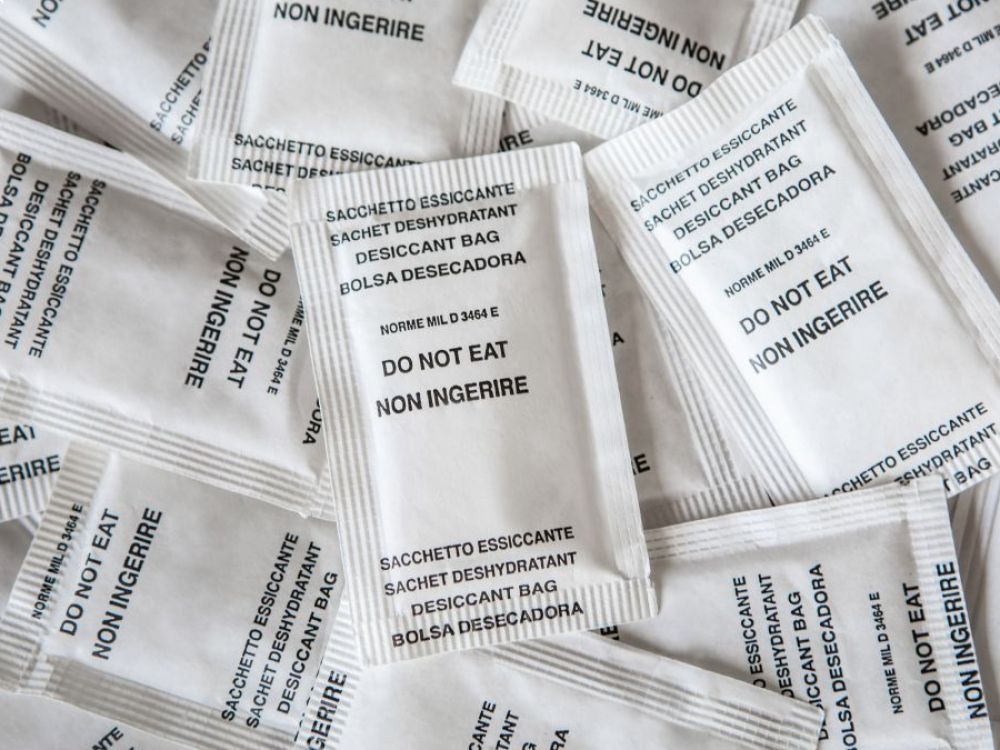
Choosing the correct desiccant bag is a fundamental step to ensure product protection during transport and storage. There is no one-size-fits-all solution: every sector, every type of goods, and every packaging requires a specific evaluation. Choosing the wrong format can compromise the effectiveness of the protection system and cause moisture-related damage, such as mold, oxidation, and deterioration.
To achieve optimal results, several technical and application factors must be considered.
The Role of the Format in Desiccant Bags
The desiccant bag format is not just about dimensions, but also absorption capacity, distribution within the packaging, and compatibility with the production process.
The bags are available in a wide range of weights, generally from 0.5 g up to over 2 g, to adapt to very different volumes: from small packages to maritime transport containers.
A correct proportion between the packaging volume and the amount of desiccant allows for maintaining a stable microclimate, avoiding both shortages and excesses of material.
Sector and Application: The First Selection Criterion
Every sector has specific needs:
-
Electronics and microcomponents: They require small formats, such as 0.5 g, 1 g, or 2 g microbags, often inserted directly into the packaging. In these cases, precise and non-invasive protection is essential.
-
Fashion, leather goods, and luxury items: In addition to the technical function, the bag must be discreet and aesthetically pleasing. Customizable microbags with a logo represent an ideal solution.
-
Pharmaceutical and medical: They require certified materials and rigorous moisture control. Formats are chosen based on the packaging volume and the sensitivity of the product.
-
Logistics and industrial transport: In this case, larger bags or specific solutions for containers are used, capable of absorbing large quantities of moisture for prolonged periods.
Packaging Volume and Duration of Protection
Another determining factor is the volume of the space to be protected. The larger the packaging, the greater the amount of desiccant required.
Similarly, the duration of transport or storage directly influences the choice of format. For short shipments, a reduced weight may be sufficient, while for long journeys or critical environmental conditions, the absorption capacity must be increased.
Type of Desiccant Material
Not all bags contain the same material. The choice of format is often also linked to the type of absorbing substance used:
-
Silica gel: versatile and suitable for many sectors.
-
Activated clay: an economical and ecological solution for standard conditions.
-
Molecular sieves: ideal for technical applications.
-
Desiccant salts: typically used in industrial packaging.
The format must therefore be consistent with the required absorption capacity.
Integration into Production Processes
In companies with automatic packaging lines, the bag format must be compatible with the systems used.
Solutions such as continuous strip bags on reels allow for rapid and precise insertion using "cut and feed" machines, optimizing times and reducing errors. In other contexts, however, manual insertion with single formats may be preferable.
Customization and Added Value
In addition to technical aspects, the format can be customized to meet branding or traceability needs. The ability to print the company logo or technical information on the microbags allows the desiccant bag to be integrated into the packaging design without compromising its aesthetics.
Choosing the right desiccant bag format means finding the right balance between absorption capacity, dimensions, application, and the production process.
Relying on an expert partner like Silital allows you to identify the most suitable solution for every sector, ensuring effective protection against moisture and preserving the quality of products throughout the entire supply chain.

