

17-11-2026
Protective Industrial Packaging: How to Prevent Damage During Transport
Discover how to protect machinery and goods during transport with barrier bags, Flex-Pack shrink fil

Transporting machinery, industrial components and delicate goods requires much more than basic packaging. During logistics operations, products may be exposed to moisture, dust, temperature fluctuations and mechanical stresses that could compromise their integrity.
Appropriate protective industrial packaging helps reduce these risks and preserve product quality from the packing stage through to delivery.
To address these needs, Silital and Flex-Pack offer complementary solutions for protecting goods through barrier materials, desiccant systems, shrink films and a wide range of corrosion protection solutions, including VCI technology.
What Are the Main Risks When Transporting Industrial Goods?
Every shipment involves specific conditions, depending on the type of goods, the length of the journey and the transport environment.
Factors that can compromise products include:
-
Moisture and condensation: can promote corrosion, oxidation and material deterioration.
-
Dust and contaminants: may settle on surfaces and the most delicate components.
-
Impacts and vibrations: can damage mechanical parts or sensitive structures during handling and transport.
-
Adverse weather and temperature fluctuations: can alter storage conditions, particularly during international shipments.
The choice of packaging must therefore take into account both the product’s dimensions and the risks it will actually face.
Barrier Bags and Desiccants: Protection Against Moisture and Other Environmental Factors
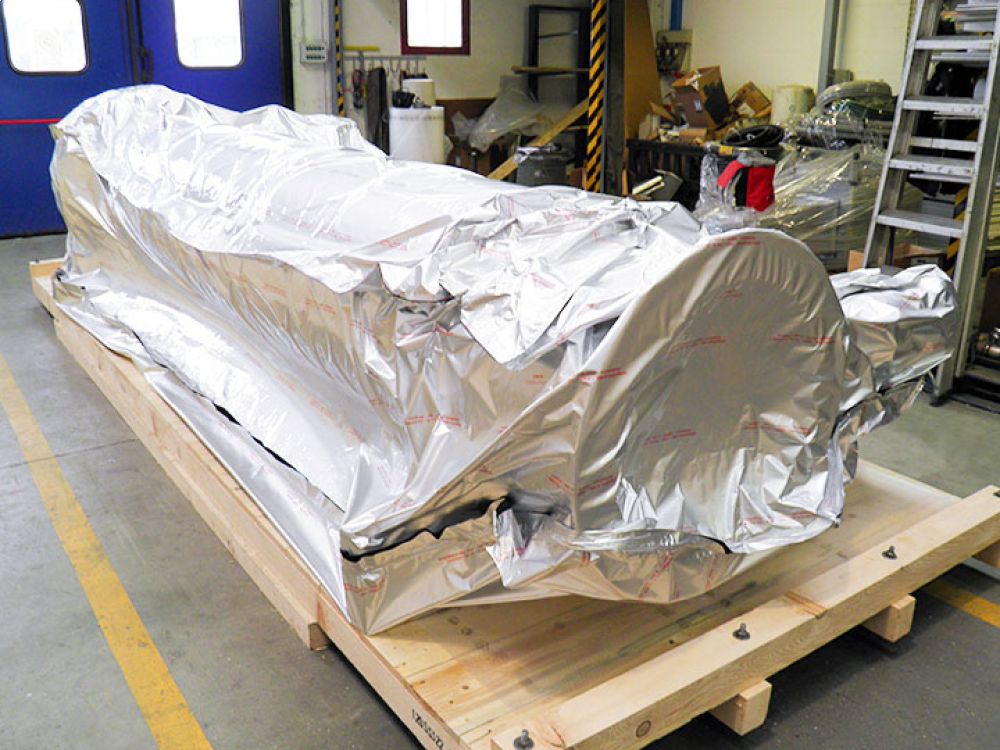
A key element of protective industrial packaging is the barrier bag, designed to isolate the product from the external environment.
The combination of barrier bags and desiccants is a particularly effective solution for moisture control: the bag limits exchange with the external environment, while the desiccants help absorb residual moisture inside the package.
Thanks to the structure of the materials used and proper sealing, the barrier bag helps limit the entry of water vapour, air and contaminants.
This solution is particularly useful for machinery, metal components and products sensitive to environmental conditions.
The effectiveness of this protection also depends on the quality of the seals and proper preparation of the product before packing.
For even more effective moisture management, barrier bags can be used with Silital desiccant sachets, which help control residual moisture inside the package.
Shrink Film: Load Stability and Protection
Alongside barrier bags, Flex-Pack shrink film plays an important role in providing external protection for goods.
When heat is applied in a controlled manner, the film shrinks and conforms to the shape of the load, creating a tight, durable covering.
This system offers several advantages:
-
Helps keep the load stable and securely wrapped.
-
Protects surfaces from direct exposure to dust and adverse weather.
-
Adapts to machinery and products of different shapes and sizes.
-
Makes packages easier to manage during extended transport and storage.
Shrink film therefore provides a particularly useful outer layer of protection for industrial shipments.
However, preventing damage from significant impacts also requires suitable securing systems and cushioning materials.
Silital and Flex-Pack: Multiple Layers of Protection
Using barrier bags and shrink film together allows different requirements to be addressed within a single packaging system.
The barrier bag provides internal protection against the entry of moisture and contaminants, while the shrink film helps stabilise the load and protect it against external factors.
These elements can be complemented by Silital desiccant products, selected according to the characteristics of the goods and the expected transport conditions.
The result is a system with multiple layers of protection:
-
Internal protection: barrier bags to limit exchange with the external environment.
-
Moisture control: desiccant sachets to reduce the risk of condensation inside the packaging.
-
External protection: shrink film to wrap and stabilise the load.
This configuration is particularly relevant for companies that need to ship machinery, industrial equipment and valuable components.
When Should You Choose Protective Industrial Packaging?
The need for an advanced protection system increases when goods face long periods of storage or shipments involving variable environmental conditions.
This is the case, for example, with sea transport, where temperature fluctuations can promote condensation.
Machinery intended for export also requires particular attention, especially when it needs to arrive at its destination in a condition suitable for installation or use.
A proper preliminary assessment helps identify the most suitable packaging materials and methods, avoiding insufficient or unnecessary protection.
Effective protective industrial packaging combines materials and solutions that address the different risks associated with handling and storage.
Integrating barrier bags, Flex-Pack shrink films and Silital desiccant systems helps improve the protection of goods by addressing both the internal environmental conditions and the load’s external exposure.
Choosing suitable packaging helps reduce damage during transport, preserve product value and make the entire logistics process more reliable.
Silital and Flex-Pack position themselves as the only suppliers in Europe equipped to meet the full range of packaging needs, with a comprehensive offering that includes crates, packaging accessories, barrier laminates and corrosion-inhibiting polyethylene materials.
This extensive offering enables companies to find solutions for their various protection, packaging and industrial transport requirements.

